Warhammer: The Old World – the world in a nutshell
The year is 2276 IC. There is no emperor, four claimants fight over the throne, Settra leads the dead against Bretonnia and Chaos stirs in the north. A guide to the age in which the battles of The Old World are fought.

Anyone who played Warhammer Fantasy remembers Karl Franz's Empire, the Colleges of Magic in Altdorf and a world hurtling towards the End Times. The Old World turns the clock back more than two hundred years. It is the year 2276 of the Imperial Calendar (IC), reckoned from the coronation of Sigmar. Karl Franz has not yet been born. There are no Colleges of Magic and no Reiksguard, and to most people the Skaven are nothing but a fairy tale.
It is a world in which the fight against the darkness can still be won. And, at the same time, a world that is only just beginning its slide towards ruin.
An Empire without an emperor
The Empire was founded by Sigmar more than two thousand years earlier, after the victory that men and Dwarfs won together at Black Fire Pass. Down the centuries it has weathered more than one catastrophe, the Vampire Wars among them, which ended with the defeat of the von Carstein line at Hel Fenn.
The roots of the trouble go back much further. After Emperor Mandred von Zelt was assassinated in 1152, the Electors could not agree on a successor. In 1360 Ottilia, Elector Countess of Talabecland, proclaimed herself Empress and declared war on her chief rival, the Elector Count of Stirland, and in 1547 the Count of Middenland declared himself Emperor as well. So began the Age of Three Emperors, and the Empire sank into a civil war that has gone on, off and on, for centuries. In 1979 the Electors who were not themselves contending for the crown elected Magritta of Marienburg as Empress. The Grand Theogonist, head of the Cult of Sigmar and holder of a seat in the Electoral College, refused to recognise the vote, the hostilities only grew, and within a few years the whole electoral system had collapsed.
So began the Anarchy, which goes on to this day. The Empire is now a collection of quarrelling city states and loose provinces ruled by pretenders, and the civil war never ends – each of them is certain that only victory over his rivals can make the nation whole again. Every one of the states still calls itself the Empire. The old provinces – Ostland, Middenland, Stirland, Averland and the rest – still have their colours and their Elector Counts, and on paper they belong to larger blocs, though in practice many of them govern themselves. Alliances and borders shift so often that the common peasant does not always know who actually rules him. Yet when Beastmen or Orcs come up to the borders, the quarrelling lords can still stand shoulder to shoulder – just as they did at Hel Fenn.
Four claimants
Four rulers are fighting for the crown:
- Elspeth Magritta VI of the Barony of Westerland, the wealthiest part of the Empire, which lives off the port of Marienburg. The young self-proclaimed Empress is swayed by the city's Burgomeisters and by the Cult of Manann, god of the sea, so her rivals mock her as the Sea Empress or the Empress of Coin.
- Count Sigismund Ulric of the Grand County of Osterlund, who rules from Middenheim. His is the house of the "Wolf Emperors" of the north, fervent followers of Ulric. The Count claims the whole of the north, but in practice he rules little more than the city itself.
- Prince Wilhelm I of Altdorf, ruler of the Principality of Reikland. A pious lord of the heartland of Sigmar's empire. Here the Cult of Sigmar reigns unchallenged, magic is outlawed, and wizards are burned at the stake.
- Duke Ludwig XII of the Grand Duchy of Talabec, of the line of Ottilia. His bloc is the largest and the most diverse, but many of its lands govern themselves, and Talabheim and Nuln are powerful city states that pay the nobility little heed. Taal is worshipped here, and wizards enjoy more freedom than anywhere else – those who live in harmony with nature are regarded as healers who bless the harvest. In Reikland this earns Talabec the name of a haven for pagans and witches.
More and more of the great cities go their own way. The most important of them is Nuln – nominally part of the Grand Duchy of Talabec, in practice a free city, an economic powerhouse and a centre of artillery. Its gunnery and engineering schools take no side and sell their guns to anyone, from Marienburg to Talabheim. No one can dictate anything to Nuln, because everyone needs its guns.
War the old way
The Empire's armies look different in this age from the ones players of the old Warhammer remember. There are dozens of knightly orders, and many of them stand apart from the politics of the claimants. Some are numerous – the Knights Panther have chapter houses in almost every major province – while others, like the Knights of the Ebon Tear, number only a few dozen warriors. The Knights Panther guard the Elector in Middenheim and keep up a friendly rivalry with the White Wolves of Osterlund, while the fanatical Knights of the Fiery Heart of Reikland stay close to the Cult of Sigmar and hunt down the worshippers of the Dark Gods. The Grand Master of the Knights Panther is Harald Gemunsen – an apolitical knight, respected on every side and one of the few who can unite the squabbling Electors against an enemy from outside. One of the Empire's finest generals, on the other hand, is Hans von Löwenhacke, a man of low birth, more mercenary than officer. He has already served many counts in many provinces, and today he fights for Nuln.
There are no colleges of magic yet – Battle Wizards, Elementalists and even Necromancers take the field, and in this age a Necromancer need not be evil. Steam Tanks rumble into battle too, built long ago by the great engineer Leonardo da Miragliano. Only twelve were ever made, and the survivors are tended by the College of Engineers. Many of the secrets of their construction have been lost, so the machines break down more and more often.
Bretonnia and its king
To the west of the Empire lies Bretonnia, the kingdom of knights. It was united centuries ago by Gilles le Breton, who won the favour of the Lady of the Lake. Today the throne belongs to King Louen Orc-Slayer – for almost eighty years now, his life lengthened by the Grail.
Orcs and Goblins have always been Bretonnia's greatest trouble. They lurk in the mountains along its borders and even in the heart of the realm, among the crags of the Massif Orcal, and no campaign has ever driven them out for good. The King earned his name in a crusade against them. Now a great horde under the warlord Spine-Cracker has poured out of the Pale Sisters hills in the north and is ravaging the lands of Gisoreux and Couronne, so the King has led his knights there in person. On top of that, the Bretonnian coast is home to High Elf enclaves: Tor Soleil, Tor Bidouze, Tor Martel and Silent Isle.
Most knights fight in the retinues of their lords, under their colours. There are also exiles: knights who broke the code of chivalry and chose to leave the realm rather than do penance. Their honour is already tarnished, so they take brigands and mercenaries into their service, even black powder troops and bombards that a true knight would scorn. And in the midst of battle the Green Knight may appear – out of a copse or the mist over a lake – champion of the Lady of the Lake and guardian of her sacred sites. He fights beside the defenders of Bretonnia and vanishes once the battle is won.

Art: © Games Workshop Limited
Settra's war
One of the great wars of the age was started by the Bretonnians themselves. In 2276 Baron Carrard of Quenelles led a crusade across the Badlands deep into Nehekhara – the Land of the Dead in the south. He meant to slay the awakening Tomb King Septhah the Amaranthine before he could leave his sarcophagus. The knights filled their saddlebags with the riches of the ancient kingdom, but the Baron fell to Septhah himself and the survivors were driven back into the Badlands. There, in a desperate battle, they nonetheless managed to slay Septhah – one of Settra's most loyal commanders – and returned to the Border Princes.
Settra the Imperishable is the King of Kings of Nehekhara. In life he brought its city-states to heel, and from his obsession with his own mortality the Mortuary Cult was born – its priests were to grant the king eternal life. He did not wish to die – he had a pyramid raised in which to await his resurrection. When the traitor Nagash cast his Great Ritual, the kings of every dynasty returned as wrathful spirits imprisoned in their own corpses. Settra ordered them to kneel. Not all did so willingly, but centuries of war between the dead cities have broken most of them. His rule is simple: bend the knee or die.
Settra would never call it revenge – revenge is a matter between equals, and he has none. He marched on Bretonnia like a master bringing an unruly dog to heel. Before 2276 was out, the fleet of the dead sailed from the port of Zandri. Settra meant first to seize the Border Princes and from there to cross the Vaults into southern Bretonnia. The vanguard under Prince Ptolethor razed the towns of Kasos and Thessos. Meanwhile the priests of the Mortuary Cult under High Priest Ashurtak searched the Badlands for Septhah's body – they massacred the Elf garrison of the tower of Tor Anrok and spent weeks beating off the raids of the local Orcs.
The Border Princes are a mountainous, mostly arid land at the crossroads of every nation. No one lays claim to the region, so it is a patchwork of petty realms whose rulers seldom last longer than a year or two. Exiled nobles and fallen warlords flee here. Long ago an emperor raised great fortresses here, and centuries later Bretonnian crusaders took the abandoned castles back from the Orcs and Goblins – and so the Border Princes began.
At the coastal town of Matorea, Settra himself found his way barred by the baron Sir Cecil Gastonne the Wyrm Slayer – a Bretonnian exile who guards the southern borders of his former homeland from his stronghold of Louen Keep. He gathered the knights of his household, peasants and mercenaries, not scorning even outcast Wizards, and quelled the panic among the town's defenders. The Duke of Brionne, Gastille the Red Hand, rode to their relief together with Lady Élisse Duchaard, the Prophetess of Brionne. On the way they smashed the vanguard of the dead at the Citadelle Bouelia, and the Duke slew Ptolethor in single combat. How the battle of Matorea ended has never been settled. All that is known is that Settra later hunted his enemies from the ruins of Matorea all the way to the walls of Louen Keep at the foot of the Vaults.
During that siege the king sent his western armies under Ashurtak through the Vaults into south-eastern Bretonnia. Along the way Ashurtak plundered forgotten tombs, came down through the Mondidier Pass, lost many of his priests and at last entered Athel Loren – in search of the power hidden in the forest of the Wood Elves. Battle was joined by the Crystal Mere.

Art: © Games Workshop Limited
The north in flames
Chaos is markedly weaker in this age, though it is growing – since 2250 the raids from the north have multiplied, and in every nation hidden cults are coming out into the open. Earlier, the Daemon Prince Be'lakor made a failed bid for power at Mordheim, possessed the eleventh Everchosen and shattered the Great Game of the Dark Gods for centuries to come. Now Chaos Undivided holds sway: most worshippers pray to any god willing to listen, only a few devote themselves to a single one, and daemons scarcely ever appear in the mortal world. Somewhere in the Chaos Wastes, however, Asavar Kul, the Beast Incarnate – the future twelfth Everchosen – is gathering his strength and the favour of the gods.
For now the danger comes from the sea. The Norscan Frydaal the Chainmaker had raided the coasts of the Empire, Bretonnia and Kislev for years until, in 2264, she went north to seek the favour of the Chaos Gods. She returned a few years later with horns on her brow and a strength she had never had before, brought several Norscan chieftains to heel and fell upon the coast of Westerland at the head of a fleet of wolfships. She sacked Hollum and raised a monument to the gods in its ruins; a year later she came back with a larger fleet, turned the town into a foothold and burned the port of Aarnau. Her goal is Marienburg itself. Magritta threw open the city's treasury and spent the whole winter training an army of mercenaries there, and in spring that army marched on Hollum.
Help came from a quarter no one expected. Miao Ying the Storm Dragon, favoured daughter of the Celestial Dragon Emperor of Grand Cathay and guardian of the Great Bastion, sailed west with the Jade Fleet. She was urged to make the voyage by her brother, Yuan Bo, the Jade Dragon, who struggles to hold the empire together in their father's absence. He had watched Chaos rising in the west and an Empire blind to the enemy at its own gates. Not long before, the Great Bastion itself had had to beat back an onslaught by the hordes of Chaos. The fleet smashed the Norscan raiders on the Sea of Claws, saw the ravaged coast of Westerland and put in at Marienburg – the first time in history that Cathay had sent an entire army west. Today Miao Ying leads the forces of Cathay and the mercenary companies of Marienburg against Frydaal in Westerland.
Nor does it end there. Beyond the Wastes, in the Shard Lands, fortresses that had no right to exist have thrown open their gates, and the lords of Chaos are waking in the frozen north. Their armies are marching through Westerland towards the border of Osterlund.
The other players
Dwarfs
The Dwarfs have been scattered since the Time of Woes, yet they are living through their Silver Age – trade with men and the inventions of the Engineers Guild bring them prosperity. They are retaking lost holds, recovering the technology of old and dreaming of the return of a golden age. The High King in Karaz-a-Karak is Alrik Alriksson. His nephew is Prince Thorgrim Ulleksson, a scholar of the Great Book of Grudges, still a long way from earning the name "Grudgebearer". The inventor Burlok Damminson is leading the reconquest of Khazid Vosk, an old engineers' outpost overrun by Orcs, even though the Engineers Guild very nearly threw him out for his reckless experiments. The Dwarfs are convinced that they have recovered Karak Eight Peaks as well, though in truth they hold only a few of its upper levels.
They have been bound to mankind by the alliance struck in Sigmar's day, but in the Empire's civil war they take no side – they act as peacemakers and trading partners. They have distrusted the High Elves since the War of the Beard, sparked when a Dwarf ambassador was shaved at the court of the Phoenix King, although more than two and a half centuries ago Phoenix King Finubar opened relations with them.
High Elves
After the War of the Beard the Phoenix King recalled his armies from the continent the Elves called Elthin Arvan, and most of the colonists returned to the island of Ulthuan. At sea, though, the Elves are still without equal. Their colonies lie on islands off the coasts of Bretonnia, Estalia, Tilea, Norsca, the Empire and Kislev, they have districts of their own in the great ports, and since Finubar's day their garrisons have guarded the coasts of the Old World. Their diplomats are fixtures at the courts of almost every ruler, Marienburg's among them. They see themselves as the guardians of the world, and some of their envoys hope to unite the quarrelling nations of men against Chaos.
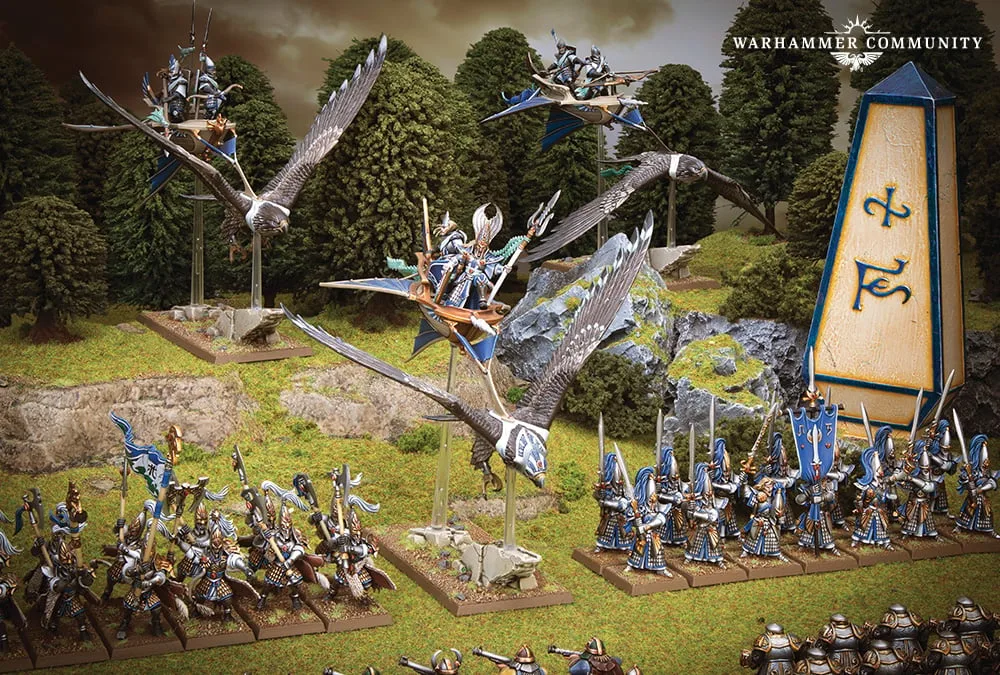
Photo: © Games Workshop Limited
Wood Elves
Orion, the King in the Woods and consort of the Eternal Queen Ariel, dies every winter on a funeral pyre and is reborn each spring in the body of a young Elf warrior. He usually comes into his full strength only at midsummer, but this spring he did not wait and rode out at once at the head of the Wild Hunt. He is hunting Kralmaw, a blind Beastman shaman known as the Prophet of Ruin, who could unite the herds. The Beastmen have pushed north into the forest of Laurelorn, until now almost free of them – its elves defended themselves alone all winter long, until in spring the spirits of Athel Loren awoke.
Beastmen
In this age the Beastmen have a purpose. Morghur, known as the Shadowgave, has been reborn – slain less than half a century ago, he is now a mewling infant, and Kralmaw is searching for him deep in the forests. The blind shaman has visions in which he also sees the coming rise of Asavar Kul. It is the Beastmen, too, who are behind the shipments of weapons from Nuln that keep vanishing in the forests of Talabecland.
Orcs and Goblins
Greenskin tribes ravage the Badlands, dragging trolls and giants in their wake, while nomadic warlords gather riders to put the Border Princes to the torch. For the Dwarfs and for Bretonnia they are the nearest threat of all. Among their shamans is Ogdruz Swampdigga – an oddball cast out by his own tribe. He wrapped himself in the hide of a dead troll, the trolls took him for one of their own and adopted him, and now they follow him around in droves.
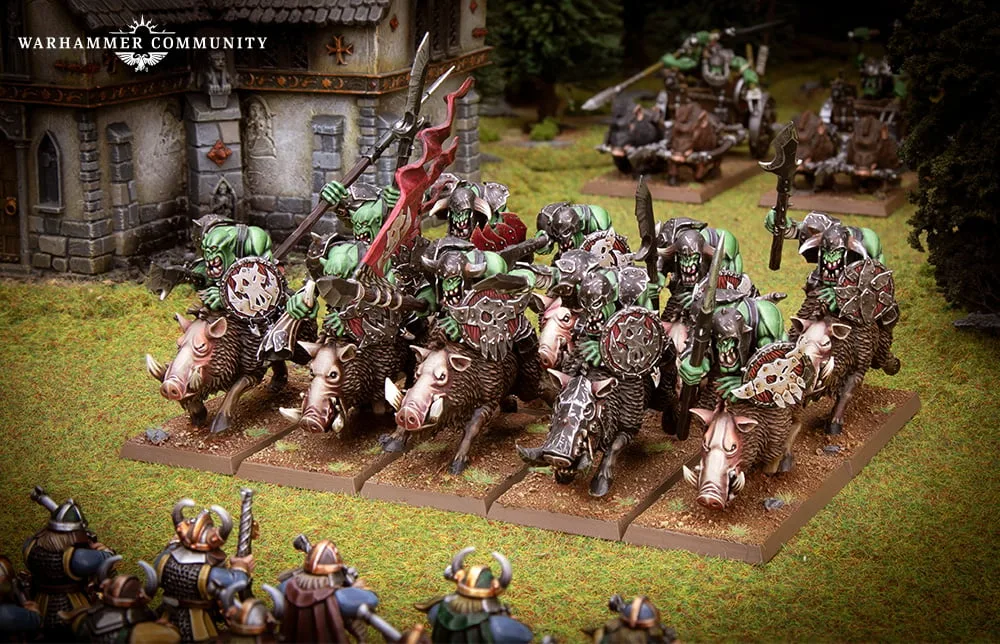
Photo: © Games Workshop Limited
Kislev
Kislev, an icy nation of warriors and of witches who wield the magic of ice, is the chief bulwark against Norsca and the hordes of Chaos. With the Empire divided, its role matters all the more. Its outposts on the eastern steppes reach all the way to the edges of Grand Cathay. It is ruled by Tzarina Mishenka Romanoff, called the Ice Queen, and her son and heir, Prince Alexis, keeps saying that the Empire must be united under a single ruler before the Dark Gods march south.
Those no one talks about
Some of the powers of the old Warhammer stand on the sidelines in this age. After their civil war the Skaven went deep underground, and to mankind they are a myth. After the fall of the von Carsteins the vampires went into hiding, and Sylvania and Hel Fenn are a sinister borderland. The Dark Elves, Lizardmen, Chaos Dwarfs and Ogre Kingdoms are far away and keep to themselves, although Ogre mercenaries turn up in the armies of the Empire and of the Orcs. Daemon Princes walk the world, but whole daemonic legions are a rarity, and the daemons of the individual gods will not appear until Asavar Kul becomes the Everchosen.
What is to come
Players of The Old World know something that the people of this world do not. In a few decades the Great War Against Chaos will come. Asavar Kul will destroy Praag and will be defeated only at Kislev. High King Alrik will be mortally wounded in that war, and his sons will fall. It will take Magnus the Pious to unite the Empire – and he will drive back Chaos, though at a terrible cost.
The game's designers say it outright: The Old World is the story of the beginning of the apocalypse. For now, though, Settra is marching west, Frydaal is burning the coast of Westerland and the four claimants are still quarrelling over the crown. Anything can still happen.
We write these articles in our spare time, with no ads. If this one helped you, ☕ buy us a coffee.